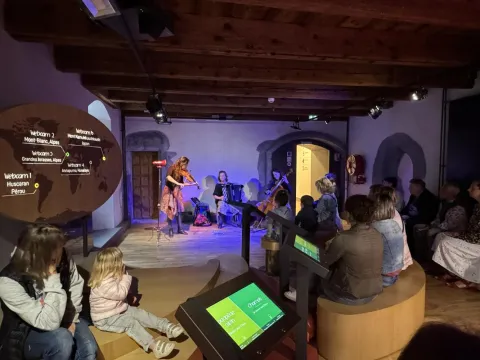
The Château des Rubins - Alps Observatory offers a modern, fun, and interactive exhibition on the theme of the mountains—with a capital "M"—all year round.
Set out on an exploration through light and sound installations to discover the many facets of life in the mountains!
The Château des Rubins – Alps Observatory opens its doors to a new exhibition featuring some 50 interactive modules spread across four floors:
1) Geology and glaciology
2) Flora and fauna
3) The history of human settlement in the mountains
4) Climate change
The new exhibition is designed for curious visitors and families. It covers more than 500 square meters, with a recommended visit duration of about two hours. The information is presented in an accessible yet accurate manner.
The Château des Rubins – Alps Observatory also offers a wide range of activities and workshops for families. These come in three formats:
1) The “Rubinoscopes”: These activities are demonstrations or experiments designed as short 15- to 20-minute segments along the exhibition route. They do not require reservations and are included in the admission price at no extra charge (a minimum of 10 people is required for the activity to take place).
2) “At the Castle Lab”: longer in duration—1 to 2 hours—these workshops emphasize hands-on experimentation, allowing participants to explore certain themes in greater depth. They are offered on Wednesdays or Sundays, by reservation, throughout the year at a rate of €6.50 per child and €8.50 per adult.
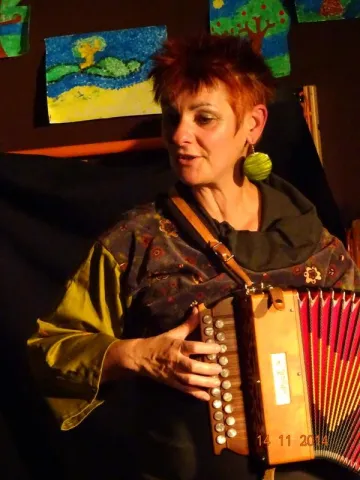
3) “Observatory Talks”: Throughout the year, the castle organizes talks with renowned experts in various fields—historians, artists, artisans, archaeologists, and more. These guests have one guiding principle: to make complex topics accessible to everyone. The talks will take place on Sunday mornings and include a welcome coffee and croissant, all for the price of a castle admission ticket (€7.50), with one event held every two months.
A gift shop selling souvenirs and local products is also open during the castle’s regular hours.
Sustainable tourism
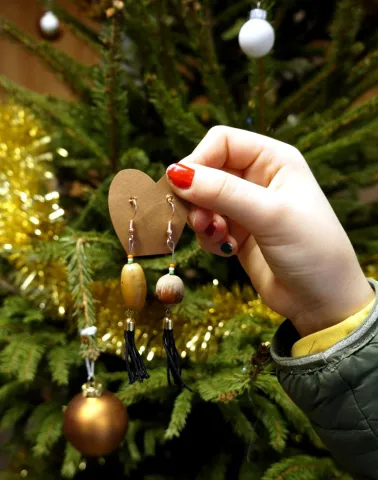
Through its exhibitions, gift shop, and events (such as days dedicated to local artisans and initiatives that highlight materials destined for the trash—such as wool and plant fibers), the Château des Rubins is committed to promoting more sustainable tourism.
History, culture and heritage
Built in the 14th century as a fortified house, the Château des Rubins was spared during the Revolution and the fire of April 19, 1840, which ravaged Sallanches.
In the 16th century, it served as the residence of the nobles of Loche, the bailiffs of Faucigny. Its massive facades are enlivened by large Renaissance-style mullioned windows. Its square tower is topped by a hipped roof resting on a crenellated wall. Its iron-clad pointed arch doorway leads to a beautiful spiral staircase.
Converted into apartments in the 19th century, it was subsequently purchased by the town in 1978.
In 1985, the Mountain Nature Center (CNM) took over the premises to create an interpretation center for Alpine natural heritage, featuring exhibits on biodiversity, educational programs and activities, exhibitions, and lectures. The renovation of the building’s basement and the various extensions added in 1997 appeared outdated and inconsistent with the castle’s heritage identity, which is why a major restoration was undertaken, with the aim of revitalizing the interiors, making the building accessible to people with limited mobility, and renovating certain windows and the entrance façade. The architectural duo of Pierre Janin and Atelier PNR stepped up to achieve this ambitious goal.
After two years of work, the Château des Rubins—Alps Observatory opened its doors in July 2021 with an innovative exhibition design consisting of some fifty interactive modules spread across four floors and covering an equal number of themes.
Key dates:
1310: Hugues, Dauphin of Viennois and Baron of Faucigny, granted the residents of Sallanches their first privileges, a sign of the town’s prosperity.
1339: The parish had 15 fortified houses and 20 noble families.
1563: By the end of the 16th century, it belonged to the de Loche family, the bailiffs of Faucigny.
18th century: It belonged to the de Chassey family, who sold it in 1754 to the chapter of the collegiate church of Sallanches.
1730: The Château des Rubins belonged to Etienne de Choulay.
1747: The ecclesiastical institution (the Chapter of Sallanches) acquired the castle from Philibert de Chasseys and Georgine de Menthon de Choulex.
1840: The Château des Rubins was miraculously spared from the flames of the great fire. It was from this date onward that the château came to be known as “Chattes Grises” (Gray Cats), because three elderly ladies dressed in gray lived there.
1978: The castle was purchased by the City of Sallanches, which housed the Mountain Nature Center there until 2019.
1997: It was renovated to include two additional floors, with a walkway connecting it to the original building.
2021: After two years of construction, it now houses the Observatoire des Alpes, a museum dedicated to the mountains, the environment, ethnology, and more.
Host portrait
Useful information
Languages spoken
Opening
- Outside of school holidays:
OPEN Wednesdays, Thursdays, Fridays, and Sundays from 10 a.m. to 6 p.m.
CLOSED on Mondays, Tuesdays, and Saturdays
- During school breaks (all regions):
OPEN Mondays, Tuesdays, Wednesdays, Thursdays, Fridays, and Sundays from 10 a.m. to 6 p.m.
CLOSED on Saturdays
Last admission at 5:00 p.m.
Please note: On Friday, October 30, the castle will close its doors early at 5:00 p.m. (last admission at 4:00 p.m.).